
Shakespeare’s Sonnet 2 Analysis: Meaning, Themes, and Line-by-Line Breakdown


Time is a predator. In the vast canon of English literature, few writers have personified the destruction of time as vividly as William Shakespeare. While Sonnet 1 demands that the "Fair Youth" procreate for the sake of the world, Sonnet 2 takes a more personal, intimidating approach. It warns the young man that his beauty is a temporary asset—one that will be ruthlessly besieged by age.
This article provides a comprehensive Shakespeare’s Sonnet 2 Analysis , exploring the intricate military metaphors, the economic language of beauty, and the desperate plea for legacy. Whether you are a university student or a literature enthusiast, this breakdown will uncover the hidden layers of one of the Bard’s most persuasive poems.
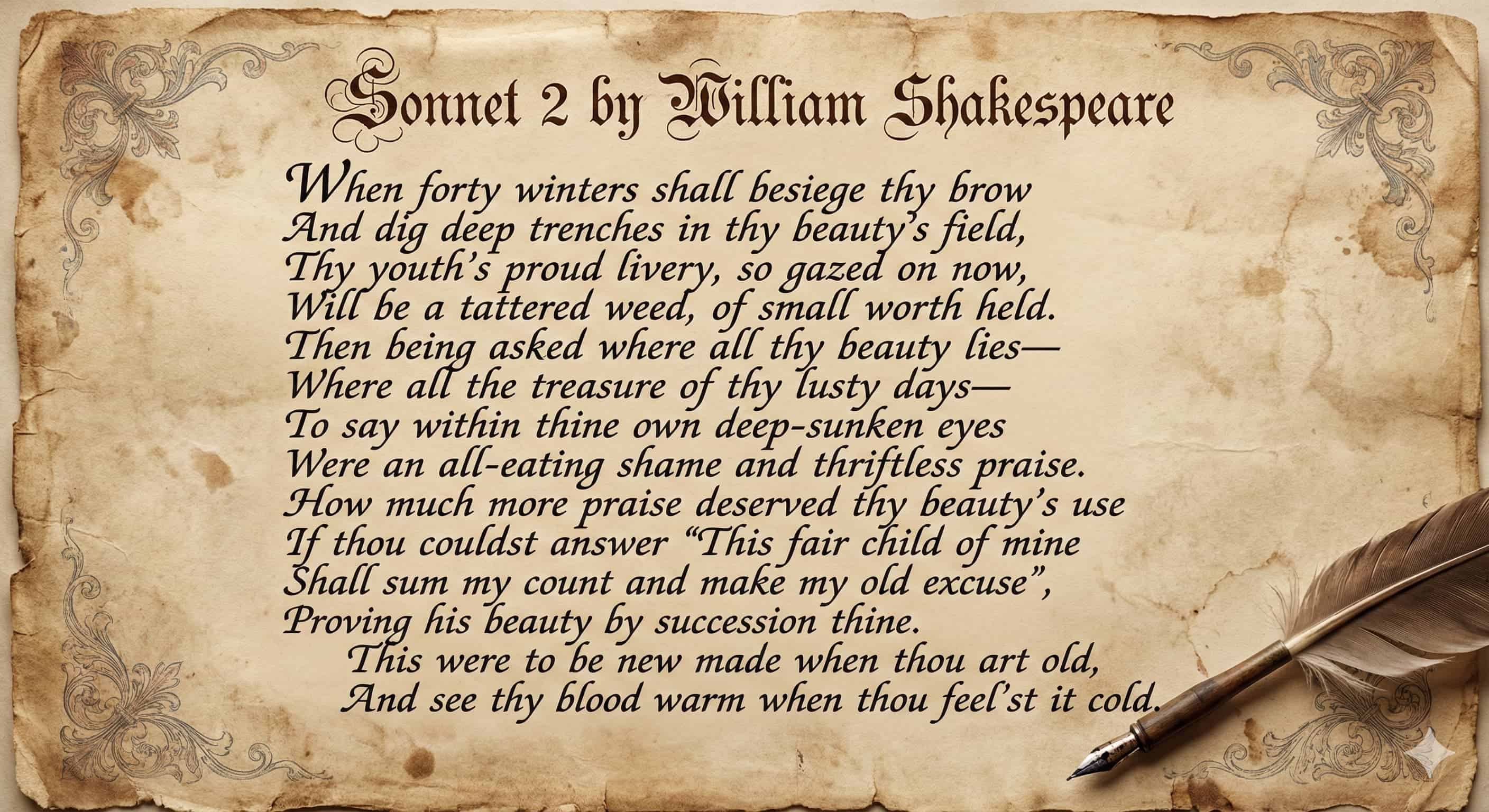
The Text: Sonnet 2 by William Shakespeare
Before analyzing the text, it is essential to read the poem to understand the rhythm and flow.
When forty winters shall besiege thy brow
And dig deep trenches in thy beauty’s field,
Thy youth’s proud livery, so gazed on now,
Will be a tattered weed, of small worth held.
Then being asked where all thy beauty lies—
Where all the treasure of thy lusty days—
To say within thine own deep-sunken eyes
Were an all-eating shame and thriftless praise.
How much more praise deserved thy beauty’s use
If thou couldst answer "This fair child of mine
Shall sum my count and make my old excuse",
Proving his beauty by succession thine.
This were to be new made when thou art old,
And see thy blood warm when thou feel’st it cold.
Modern Translation: Sonnet 2 Paraphrase
Shakespearean English can be dense. To fully grasp the Shakespeare’s Sonnet 2 analysis, here is a plain English translation of what the speaker is actually telling the young man:
- Quatrain 1: When you are forty years old, time will attack your face like an army. It will dig wrinkles (trenches) into your skin. The youthful beauty you wear now like a proud uniform will eventually look like a ragged, worthless piece of clothing.
- Quatrain 2: When people ask you, "Where did your beauty go? Where is the treasure of your energetic youth?" it would be shameful to point to your own sunken, old eyes. That admits you used it all up on yourself.
- Quatrain 3: Think of how much better it would be if you could answer that question by pointing to your son and saying, "This child proves I used my beauty well. He is the sum of my life."
- Couplet: Creating a child would make you new again even when you are old. You would see your blood flowing in him, even as your own blood runs cold with age.
Line-by-Line Critical Analysis of Sonnet 2
This poem is part of the "Procreation Sonnets" (Sonnets 1–17), where the speaker urges the Fair Youth to marry and have children. However, the tone here shifts from a request to a warning.
Quatrain 1 (Lines 1-4): The Siege of Time
The poem opens with a violent, aggressive metaphor. Shakespeare does not describe aging as a natural process; he describes it as a war.
- "When forty winters shall besiege thy brow": In Elizabethan England, forty was considered the threshold of old age. The use of "winters" rather than "years" emphasizes the cold, barren nature of aging. The word "besiege" introduces the military metaphor. Time is an army surrounding the youth’s face (the fortress).
- "And dig deep trenches in thy beauty's field": The "trenches" serve a double meaning. In warfare, trenches are defensive ditches; on the human face, they are wrinkles. The "beauty's field" suggests the face is a landscape being destroyed by this battle.
- "Thy youth's proud livery... a tatter'd weed": "Livery" refers to a distinct uniform worn by a servant or official. Here, youth is a uniform the young man wears proudly. Shakespeare warns that this expensive clothing will eventually become a "tatter'd weed" (ragged clothing), signifying a total loss of social status and aesthetic value.
Quatrain 2 (Lines 5-8): The Shame of Narcissism
The argument shifts from military to economic imagery. Shakespeare treats beauty not just as a physical trait, but as a resource or currency that must be invested.
- "Where all the treasure of thy lusty days": The speaker anticipates a future interrogation. The word "treasure" implies beauty is wealth. "Lusty" in this context refers to vigor, energy, and sexual vitality.
- "Deep-sunken eyes": This image contrasts sharply with the "bright eyes" usually associated with youth. It represents the skull beneath the skin—a reminder of mortality (memento mori).
- "All-eating shame and thriftless praise": This is a scathing critique. "Thriftless" means wasteful. To hoard one's beauty and not reproduce is "gluttonous" (all-eating). If the youth keeps his beauty to himself, it dies with him. That is a waste of capital.
Quatrain 3 (Lines 9-12): The Solution (Legacy)
After presenting the problem (aging) and the shame of doing nothing (narcissism), Shakespeare offers the solution: a child.
- "Shall sum my count": This continues the financial metaphor. A child is the "sum" or the final audit of the man's life account. The child balances the books.
- "Make my old excuse": The child justifies the father's existence. The father can point to the child and say, "I did not waste my life; here is the proof."
- "Proving his beauty by succession thine": This introduces the legal concept of succession. The child is the rightful heir to the father's beauty.
The Couplet (Lines 13-14): The Final Verdict
The sonnet concludes with a rhyming couplet that summarizes the emotional core of the argument.
- "New made when thou art old": This is the promise of resurrection. Through a child, the father is "remade."
- "See thy blood warm when thou feel'st it cold": A visceral, physical contrast. Old age brings "cold blood" (death/lethargy), but the sight of the child proves that the family line (blood) is still "warm" and alive.
Major Themes in Sonnet 2
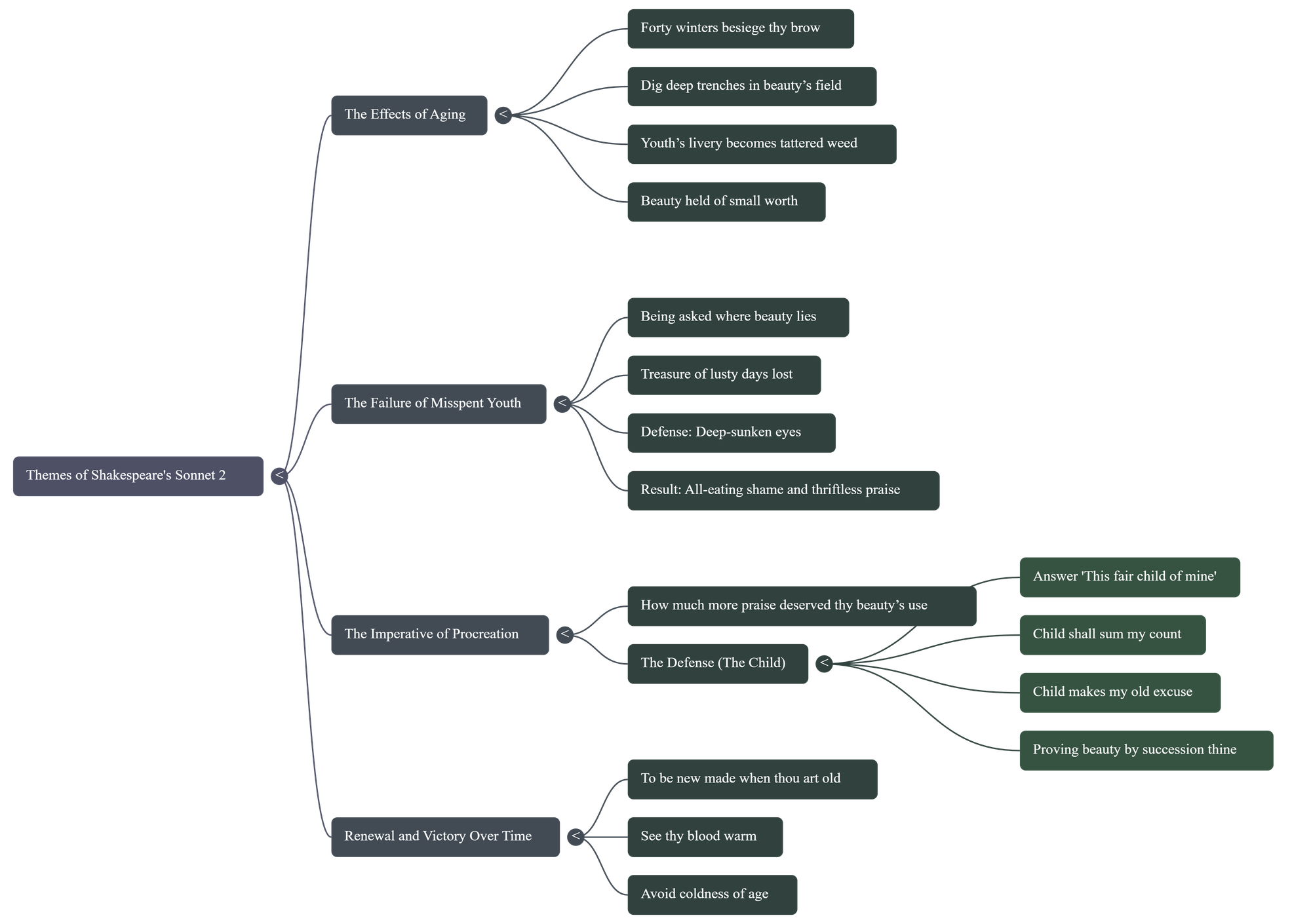
To write a strong Sonnet 2 William Shakespeare analysis, one must understand the three pillars holding the poem together.
1. The Ravages of Time
Shakespeare was obsessed with the destructive power of time. In Sonnet 2, time is an active antagonist. It besieges, digs, and tattered the youth. There is no negotiating with time; it conquers everyone. The only defense is to leave something behind that time cannot kill immediately—an heir.
2. Beauty as Economic Currency
The poem is saturated with financial terms: treasure, thriftless, sum, count, use, succession. Shakespeare argues that beauty is not a gift to be kept, but a loan to be invested. In the Elizabethan worldview, hoarding wealth (usury or miserliness) was sinful. Hoarding beauty is equally sinful. The "Fair Youth" is treating his beauty like a miser treats gold—hiding it until it loses value.
3. Procreation as Immortality
Since the individual cannot survive forever, the species must. The sonnet suggests that biological reproduction is the only form of immortality available to humans. The child is a "copy" of the father, ensuring the original is not forgotten.
Literary Devices and Poetic Techniques
For students focusing on the technical construction of the poem, these devices are essential.
- Metaphor: The dominant metaphors are War (winter besieging the brow), Agriculture (beauty's field), and Commerce (audit, sum, treasure).
- Alliteration: Shakespeare uses repeated consonant sounds to create rhythm and emphasis.
- "Forty fortress" (implied in the sound of forty/field)
- "Dig deep" (emphasizes the harshness of the wrinkles).
- "Livery... lusty" connects the uniform of youth with energy.
- Iambic Pentameter: Like most sonnets, this is written in iambic pentameter (ten syllables per line, alternating unstressed and stressed).
- When forty winters shall besiege thy brow
- The regular rhythm underscores the steady, unstoppable march of time.
Sonnet 2 Analysis by William Shakespeare analysis Mind Map
People Also Ask (FAQ)
Who is the "Fair Youth" in Sonnet 2? While the identity is debated, most scholars believe the "Fair Youth" is Henry Wriothesley, the Earl of Southampton, or perhaps William Herbert, the Earl of Pembroke. The poem is addressed to a young, beautiful man of high social standing.
What does "tatter'd weed" mean in the context of the poem? In Elizabethan English, a "weed" was a garment or piece of clothing. A "tatter'd weed" refers to worn-out, ragged clothes. Shakespeare uses this to symbolize how the youth's smooth skin will become wrinkled and worthless.
How does Sonnet 2 connect to Sonnet 1? Sonnet 1 focuses on the duty to the world ("From fairest creatures we desire increase"). Sonnet 2 shifts the focus to the fear of aging. It personalizes the threat, making the argument more about the young man's vanity and future regret.
Conclusion
Sonnet 2 serves as a reality check. Shakespeare dismantles the arrogance of youth by holding up a mirror to the inevitable future. He argues that beauty without legacy is "thriftless"—a waste of potential.
By combining the violence of a military siege with the cold logic of accounting, Shakespeare constructs an irrefutable argument: You will get old, and you will die. The only way to "warm your blood" again is to see it flowing in the veins of your child.