
Sonnet 3 by William Shakespeare: Analysis, Summary, and Meaning


Introduction: The Mirror and the Mother
When we approach the early sonnets of William Shakespeare, we aren't just reading love poems; we are witnessing an argument. Sonnet 3 is a critical part of the "Procreation Sonnets" (Sonnets 1–17), a sequence where the speaker urges a beautiful young man—the "Fair Youth"—to marry and have children.
While Sonnet 1 introduces the concept of procreation as a duty to the world, Sonnet 3 makes it personal. The speaker stops talking about "fairest creatures" in the abstract and commands the youth to look in the mirror. It is a poem about vanity, duty, and the ruthless passage of time.
Below is a detailed Sonnet 3 by William Shakespeare analysis, breaking down the text line-by-line to uncover the urgency behind the poet's words.
The Complete Text of Sonnet 3
Before analyzing the structure, it is essential to read the poem in its entirety to hear the rhythm and the shifting tone.
Look in thy glass and tell the face thou viewest,
Now is the time that face should form another,
Whose fresh repair if now thou not renewest,
Thou dost beguile the world, unbless some mother.
For where is she so fair whose uneared womb
Disdains the tillage of thy husbandry?
Or who is he so fond will be the tomb
Of his self-love, to stop posterity?
Thou art thy mother’s glass, and she in thee
Calls back the lovely April of her prime;
So thou through windows of thine age shalt see,
Despite of wrinkles, this thy golden time.
But if thou live rememb’red not to be,
Die single, and thine image dies with thee.
Line-by-Line Analysis of Sonnet 3
Shakespeare follows the classic English sonnet structure here: three quatrains (four-line stanzas) followed by a final rhyming couplet. The argument evolves with each section.
Quatrain 1 (Lines 1–4): The Mirror and the Mold
The poem opens with a direct imperative: "Look in thy glass."
The speaker challenges the youth to confront his own reflection. The argument here is distinct. If the youth loves his own face (which the speaker knows he does), he has an obligation to replicate it. The phrase "form another" implies that the youth is currently just a mold or a pattern. If he fails to cast a new copy from that mold, he is wasting the design.
Shakespeare uses strong, accusatory language here. If the youth refuses to procreate, he is guilty of two crimes:
- Beguiling the world: He is cheating the world out of his beauty.
- Unblessing a mother: He is denying a woman the happiness of bearing his child.
Quatrain 2 (Lines 5–8): The Husbandry Metaphor
In the second quatrain, the speaker shifts from the mirror to the soil. This is a classic example of Shakespearean agricultural imagery.
For where is she so fair whose unear'd womb / Disdains the tillage of thy husbandry?
The term "unear'd" here means unplowed. The speaker asks a rhetorical question: Is there any woman so beautiful or proud that she would reject the youth's "husbandry" (farming/management)? The implication is no. The youth is so desirable that any woman would accept him.
The poet then flips the question to the youth’s own psychology. He asks who would be so "fond" (foolish) to become the "tomb of his self-love." This is a paradox. Usually, self-love leads to preservation. Here, Shakespeare argues that extreme self-love leads to death (a tomb) because it stops the family line ("posterity").
Quatrain 3 (Lines 9–12): The Mother’s Image
This is perhaps the most persuasive section of the poem. The speaker pivots to the youth’s own origin.
Thou art thy mother's glass, and she in thee / Calls back the lovely April of her prime;
Just as the youth looks into a mirror, his mother looks at him to see her own youth. He is her living reflection. The reference to the "lovely April of her prime" evokes the spring of life—youth, fertility, and freshness.
The argument extends into the future. Just as his mother finds joy in seeing her youth reflected in him, he too will one day look through the "windows of thine age" (his own old, failing eyes) and see his "golden time" reflected in his own child. It is a promise of immortality through lineage.
The Couplet (Lines 13–14): The Final Ultimatum
The volta (turn) in the final two lines delivers a harsh warning.
But if thou live, remember'd not to be, / Die single and thine image dies with thee.
The tone shifts from persuasive to funereal. If the youth chooses to live only for himself, without the desire to be remembered, the consequence is total erasure. To "die single" is to let the specific, unique image of his beauty vanish from the earth forever.

Key Themes in Sonnet 3
To fully grasp this Sonnet 3 by William Shakespeare analysis, we must identify the core themes that drive the poem.
- Narcissism vs. Duty: Shakespeare acknowledges the youth's vanity but weaponizes it. He argues that true self-love requires reproduction. If you love yourself, you should want to see more of yourself in the world.
- The Ravages of Time: Time is the villain in almost all of Shakespeare’s sonnets. Here, "wrinkles" and "age" are inevitable. The only defense against Time’s destruction is biological succession.
- Beauty as Borrowed Capital: The underlying philosophy is that beauty is not a gift to be hoarded, but a loan to be invested. Hoarding beauty is a misuse of nature's resources.
Literary Devices and Stylistics
For the student or academic reader, noting the specific devices elevates the analysis.
- Polyptoton: Shakespeare loves repeating words with slight variations. In line 1, he uses "tell" and "viewest," and connects them to "face" and "form."
- Metaphor: The dominant metaphor in Quatrain 2 is agricultural ("tillage," "husbandry," "unear'd"). This connects human reproduction to the natural, seasonal cycles of the earth.
- Rhyme Scheme: The poem follows the standard Elizabethan structure: ABAB CDCD EFEF GG. The rigid structure reflects the logical, step-by-step argument the speaker is building.
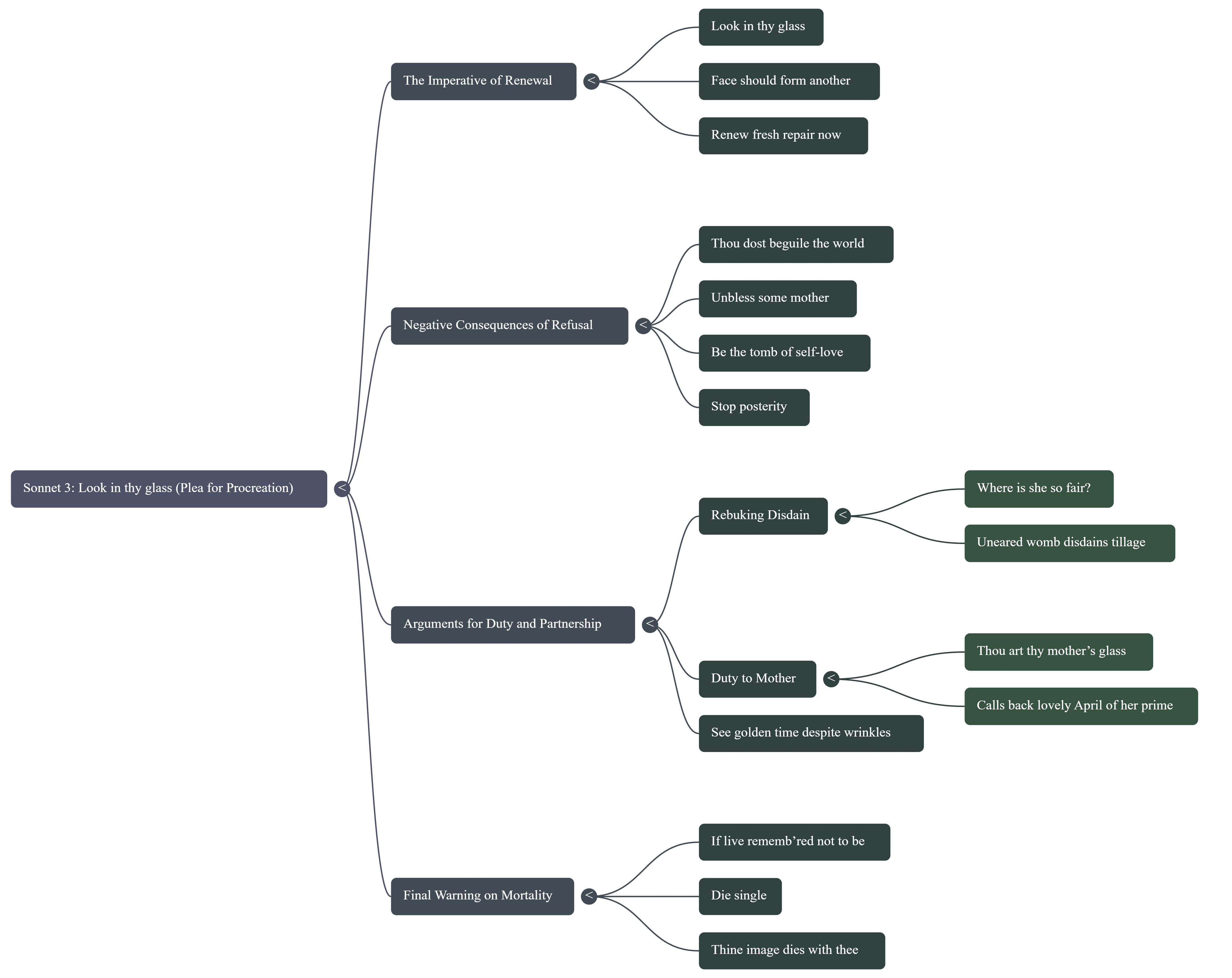
Sonnet 3 by William Shakespeare analysis Mind Map
People Also Ask (FAQ)
What is the main message of Sonnet 3? The main message is that the young man has a moral obligation to have children. By refusing to procreate, he is wasting his beauty and cheating the world (and himself) of his genetic legacy.
To whom is Sonnet 3 addressed? Like the other Procreation Sonnets, this poem is addressed to the "Fair Youth," an unnamed, beautiful young man who serves as the poet's muse. His identity remains one of literature's greatest mysteries, though candidates include Henry Wriothesley or William Herbert.
What does "lovely April of her prime" mean? This phrase refers to the youth and beauty of the young man's mother when she was in her best years. Shakespeare uses "April" to symbolize spring, fertility, and the beginning of life.
Conclusion: The Tragedy of the Unreflected Face
In the end, Sonnet 3 is a poem about potential energy. Shakespeare looks at the young man and sees a waste of resources. The poem moves from the cold glass of a mirror to the warm memory of a mother, trying every emotional lever to convince the youth to act.
The power of this Sonnet 3 by William Shakespeare analysis lies in realizing that the poet isn't just asking the youth to have sex; he is asking him to defeat death. To "die single" is the ultimate failure, a victory for Time over Beauty.